



Today, cybersecurity is a necessity for any network, whether domestic, business, or industrial.
Protection must be accessible to everyone, regardless of the size or budget of the infrastructure. In this article, we will explore OPNsense, an open-source firewall that offers advanced security and flexibility.
In addition, we will see how InprOTech GUARDIAN integrates with different firewalls to offer optimal cybersecurity service, especially in industrial environments.
History and origin

OPNsense was born in January 2015 as a fork of pfSense, which in turn descends from the m0n0wall project. The main motivation for this separation was to have a clearer code base, a more open development community, and a BSD license that offered greater flexibility. Since its inception, the project has remained an open initiative in which users and developers from around the world collaborate, backed by the company Deciso, which also manufactures hardware optimized for OPNsense and offers professional support. The pace of development is steady: two major releases are published each year, supplemented by biweekly security updates. OPNsense Business Edition is qualified in the CPSTIC (Catalog of ICT Security Products and Services) for use in accordance with ENS in specific versions evaluated by the CCN. With this model, the project combines sustained evolution and verifiable guarantees for public and private environments.
Architecture and components
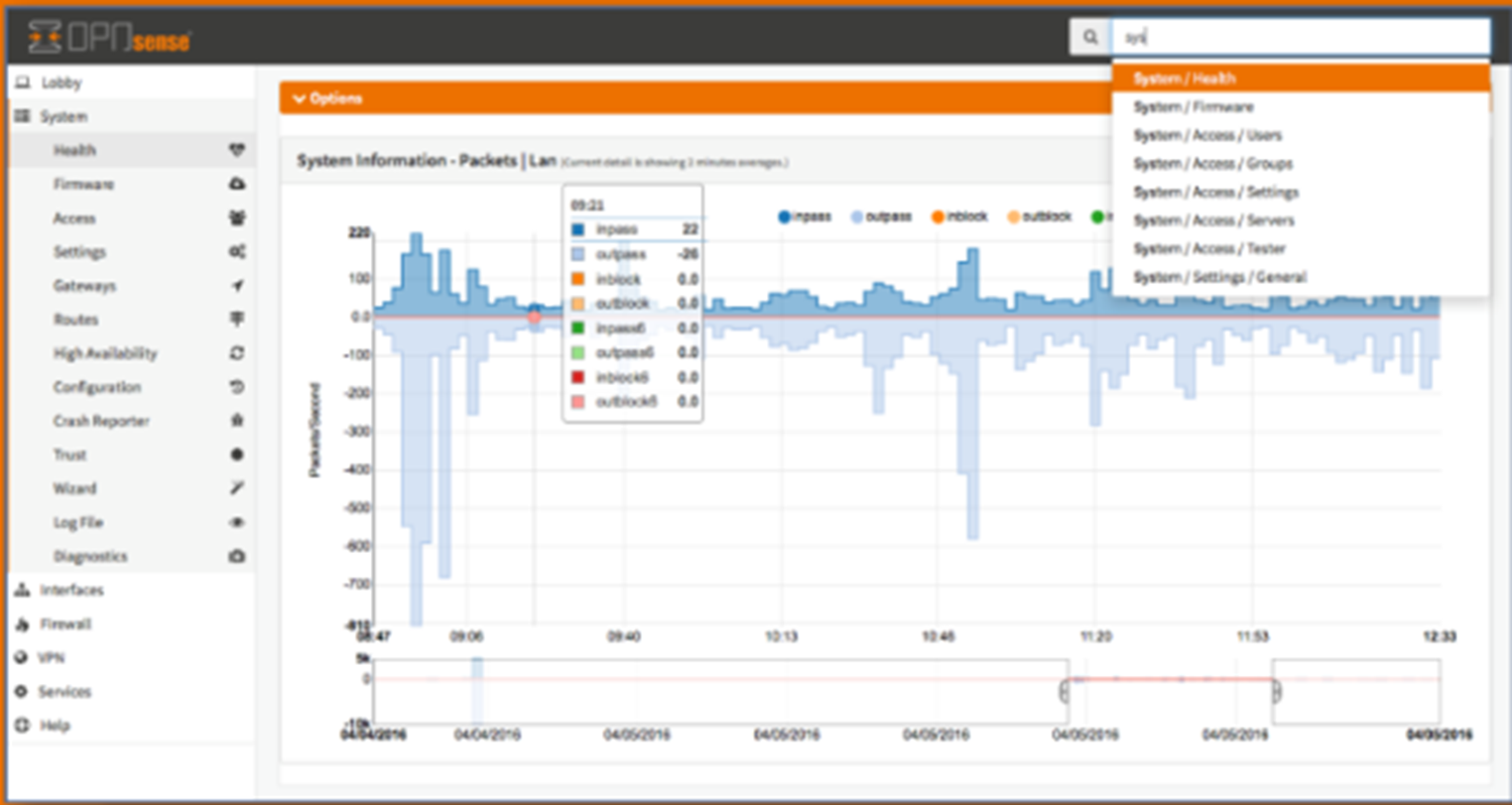
The strength of OPNsense lies not only in its intuitive interface, but also in the solid architecture on which it is built. Here are some of the fundamentals and modules that bring it to life:
System base
OPNsense is based on FreeBSD, a robust and mature operating system that is widely recognized in the networking world, inheriting stability, performance, and a well-proven ecosystem of utilities.
Its design follows a modular logic, where each component fulfills a specific role and can be extended or updated. Its BSD license reinforces the open nature of the project, allowing both companies and independent users to contribute and reuse the code.
Network interfaces and roles
Flexibility in interface management is another of its strengths. OPNsense supports IPv4 and IPv6 and allows you to define different network roles:
- WAN: connection to the internet
- LAN: internal user network
- DMZ: intermediate zone for public servers
- VLANs: network segmentation using 802.1Q tags
In addition, it supports advanced configurations such as multi-WAN or the use of transparent bridges.
Key internal modules
OPNsense consists of a series of subsystems that cover most network security and management needs:
- Firewall: tracks active connections to apply rules
- NAT: essential for connecting multiple computers to the internet with a single public IP address
- VPNs: facilitate secure interconnection between remote locations and users
- IDS/IPS: for deep traffic inspection
- QoS / traffic shaping: prioritizes or limits traffic according to business needs
- High availability: ensuring continuity in the event of hardware failure
- Logging and monitoring systems: essential for auditing and diagnostics
Extensibility and plugins
OPNsense offers a repository of plugins that extend its capabilities. It also has an API, which facilitates integration with external tools and task automation.
Advantages of OPNsense
OPNsense has strengths that make it a very attractive alternative to other firewalls.
- Open source and BSD license
- Frequent updates
- Modern and easy-to-use interface
- Active community
- Plugin system
- Advanced features
- Deployment flexibility
- CPSTIC certified for use in accordance with ENS
Limitations and disadvantages
Like all technologies, it also has certain disadvantages that should be considered before adopting it in a production environment:
- Limited scalability under very high loads
- Hardware compatibility
- Learning curve
- Incomplete documentation in advanced cases
- CPSTIC certification is not generic, only for specific versions
- Potential lack of support or continuity due to not having a manufacturer to back it up
InprOTech GUARDIAN
InprOTech GUARDIAN is a cybersecurity technology designed specifically to protect industrial networks and production environments. Its value lies in continuous traffic monitoring, combining different technologies (static rules, IDS, AI algorithms, and honeypots), which allows it to learn from network traffic, detect anomalies and potential threats in real time, identify vulnerabilities, and inventory network assets.
Beyond detection, GUARDIAN incorporates active blocking capabilities, allowing it to integrate with firewalls, such as OPNsense and solutions from other manufacturers, to respond to the detection of connections to malicious external IPs (whether they are the source or destination of communications). This integration can operate in different modes: from simple notification to manual or fully automatic blocking of suspicious addresses.
Resources
[1] https://docs.opnsense.org/index.html
[2] https://www.pfsense.org/
[3] https://m0n0.ch/wall/index.php
[5] https://ccnadesdecero.es/opnsense-vs-pfsense/
[6] https://www.rootsolutions.com.ar/opnsense-firewall-utm-opensource-cuenta/
[7] https://backsec.net/opnsense-que-es/
[8] https://inprotech.es/guardian/
[9] https://cpstic.ccn.cni.es/es/catalogo-productos-servicios-stic/377-opnsense-business-edition25-4
[10] https://ens.ccn.cni.es/es/